


Ketamine has carried multiple identities for decades: surgical anesthetic, party drug, and, in the media and public imagination, a horse tranquilizer. The label is technically accurate but deeply misleading. Ketamine was developed for humans first, and its current use in mental health treatment is a promising development in modern psychiatry.
A medicine once mainly used in operating rooms and veterinary clinics has become a catalyst for emotional healing. Ketamine is used to treat treatment-resistant depression, anxiety disorders, and post-traumatic stress disorder (PTSD). It’s also used for acute pain relief and, in some clinics, for addiction support. This history of ketamine reveals how science, stigma, and innovation often intersect in unexpected ways.
Key Takeaways
- Ketamine was developed for humans and later adopted in veterinary medicine.
- Its use in mental-health treatment represents a significant clinical shift.
- The “horse tranquilizer” label is technically accurate but profoundly incomplete.
- Controlled, low-dose ketamine can rapidly relieve depression and PTSD symptoms.
- Its true potential lies in helping people reconnect, not as a sedative.
Origins and Dual Identity of Ketamine
Ketamine was first synthesized in the early 1960s by chemist Calvin Stevens, who was searching for a safer alternative to an anesthetic with severe side effects. Ketamine quickly proved to be comparatively fast-acting, short-lasting, and remarkably safe in medical settings, qualities that made it ideal for treating humans.
By 1970, ketamine received U.S. Food and Drug Administration approval for anesthesia in humans. Surgeons valued it for maintaining blood pressure and breathing even in deep sedation. Soon after, veterinarians recognized its versatility and began using it across species, from horses to cats.
That overlap gave rise to the now-familiar label: “horse tranquilizer.” While not untrue, it tells only part of the story. Ketamine’s use in veterinary medicine is one small branch of its much broader medical lineage.
Veterinary Applications and Media Mythmaking
Ketamine remains a staple in animal medicine because it works quickly, reliably, and safely as an anaesthetic. For large animals such as horses, it allows short procedures with minimal distress and rapid recovery. It’s also widely used for cats, dogs, and small mammals, pointing to its adaptability rather than its suitability for horses.
The “horse tranquilizer” phrase began to appear in tabloids and television segments in the late 1980s, often tied to concerns about recreational misuse. The phrase stuck because it sounded provocative. It simplified a complex pharmacological story into a sensational image.
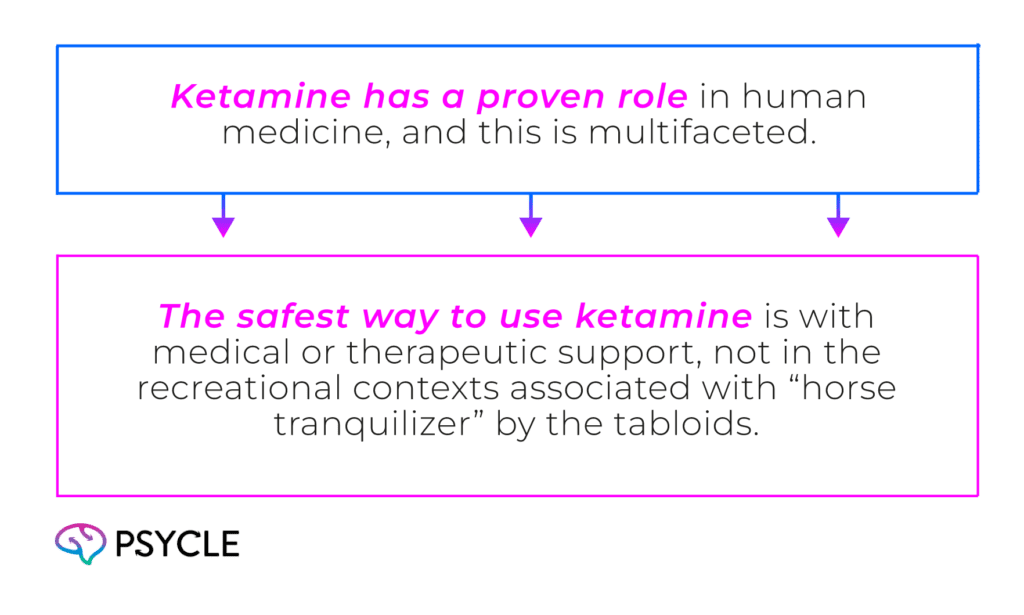
That framing persists today, even as thousands of people undergo ketamine therapy for depression and post-traumatic stress in clinical settings. The shorthand may attract attention, but it obscures two key matters:
From Anesthesia to Antidepressant: Ketamine’s Medical Evolution
For decades, ketamine was best known in emergency rooms and battlefields. Its stability under harsh conditions made it indispensable for surgery and trauma care. Unlike many anesthetics, it doesn’t suppress breathing, a crucial safety feature in field medicine.
But in the early 2000s, something unexpected happened. Researchers noticed that small doses of ketamine produced rapid relief in people with severe, treatment-resistant depression. Symptoms that had persisted for years lifted within hours. This speed was unlike anything seen with conventional antidepressants, which can take weeks to work.
Since then, ketamine has become one of psychiatry’s most studied and debated medicines. Ketamine is now used to treat many different conditions, including major depressive disorder, bipolar depression, PTSD, suicidal ideation, as well as chronic pain and migraines.
Unlike traditional antidepressants, which act primarily on serotonin, ketamine targets glutamate, the brain’s primary excitatory neurotransmitter. This difference allows it to interrupt rigid emotional and cognitive loops that often underpin depression and anxiety. The result is not just symptom reduction, but a renewed capacity to feel, think, and connect.
Mechanism of Action: Why It Works Differently
Ketamine acts as an NMDA receptor antagonist, disrupting a key signaling pathway in the brain. This disruption triggers a rapid increase in glutamate release, which, in turn, stimulates new connections between neurons — a process known as synaptic plasticity.
In plain terms, ketamine helps the brain rewire itself. It reopens flexibility in areas that have become locked by chronic stress, trauma, or depression. That neuroplastic window may explain why even a few carefully guided sessions can produce lasting improvement.
Ketamine is distinct from classic psychedelics such as psilocybin or LSD. It is a dissociative, meaning it can create a sense of distance from one’s thoughts or body. In a therapeutic setting, this detachment often helps people access experiences or emotions that felt unreachable.
At its best, ketamine allows the mind to step outside itself just long enough to see things differently, offering a pause that can reset deeply entrenched patterns.
Psychedelic Therapy and the Emotional Reset
Ketamine-assisted psychotherapy (KAP) combines the neurochemical effects of ketamine with guided psychological support. Sessions involve low doses, and patients remain conscious but relaxed. The experience can feel dreamlike, with time distortion and softened boundaries between thought and feeling.
Therapists often describe this state as one of “expanded perspective.” It allows patients to revisit painful memories, reframe self-criticism, and reconnect with emotion without becoming overwhelmed.
Integration — the process of reflecting and making meaning after a session — helps anchor these insights. People often report increased compassion for themselves, more clarity about relationships, and a sense of relief from mental constriction.
For some, ketamine therapy is a pathway between crisis and clarity — a way to create space for healing that talk therapy alone could not reach.
Current Clinical Uses and Research Expansion
Today, ketamine is used both as a hospital-based anesthetic and a rapidly acting psychiatric treatment. Esketamine, a derivative marketed as Spravato®, became the first FDA-approved ketamine-based nasal spray for depression in 2019. Spravato addresses treatment-resistant depression and acute suicidal ideation.
Beyond depression, research continues into ketamine’s potential across a spectrum of conditions:
- PTSD and trauma-related disorders
- Obsessive-compulsive disorder (OCD)
- Substance and alcohol use disorders
- Eating disorders
- Chronic pain syndromes
- End-of-life anxiety
Many studies explore how ketamine interacts with psychotherapy, somatic work, or mindfulness to enhance long-term results. Early evidence suggests that the most durable improvements occur when the shifts catalyzed by a ketamine experience are then continuously processed in therapy sessions.
In that sense, ketamine is reshaping mental-health treatment not just through chemistry but through the model of care it invites: one that integrates biology, psychology, and meaning.
Shifting the Narrative: From Sedation to Transformation
The “horse tranquilizer” narrative reduces ketamine to a very narrow vision of its full potential. Its veterinary use is real, but its psychiatric impact can be revolutionary. For people who have cycled through multiple medications without relief, ketamine can offer a turning point, sometimes within hours.
Clinics across the world now offer ketamine therapy under medical supervision, pairing it with talk therapy and integration coaching. Patients often describe feeling “unstuck,” more open, or suddenly more able to engage with others.
The transformation isn’t about escape; it’s about regaining access to emotional range. The same properties that once made ketamine a reliable anesthetic now make it an unparalleled tool for mental-health renewal.
The Future of Ketamine Therapy
As the field matures, ketamine is paving the way for a broader acceptance of psychedelic-assisted therapy. Its clinical safety profile, short duration, and well-studied mechanisms have made it an early model for how modern psychiatry can responsibly approach psychedelic medicines.
New approaches include:
- In-clinic infusions: precise dosing under supervision.
- Nasal or oral protocols: for accessibility and maintenance.
- Group models: blending peer support with guided reflection.
- Hybrid care: with integration therapy at home via telehealth between sessions.
Researchers are also exploring how ketamine interacts with other healing modalities such as mindfulness training, EMDR, and somatic therapy. Early findings suggest it may accelerate emotional learning and resilience.
What began decades ago as a battlefield anaesthetic and became a veterinary sedative has also evolved into one of today’s most promising mental health treatments. Ketamine’s history is unconventional, yet its trajectory is unmistakable — reshaping how psychiatry can address depression, trauma, and suicidality when other treatments fail.
Administered in low, carefully monitored doses, ketamine can lift depression within hours, offering a shift where traditional medications take weeks or never work at all. The “horse tranquilizer” label lingers in pop culture, but its meaning fades each time a patient finds real relief after years of suffering.
In the right hands, ketamine isn’t a tranquilizer at all, but a treatment that can make genuine improvements to mental health possible and allow a person to reengage more fully with life.
FAQs
Why Do People Call Ketamine a Horse Tranquilizer?
Veterinarians use ketamine to sedate large animals. However, ketamine was initially developed for humans and remains widely used in human anesthesia and psychiatry.
How Does Ketamine Help With Depression and Anxiety?
Ketamine increases glutamate release and promotes the formation of new neural connections, helping the brain regain flexibility and emotional responsiveness.
Is Ketamine Physically Safe for Therapy?
Yes. In clinical settings, supervised by trained professionals, ketamine has a strong safety record. Side effects such as dizziness or mild dissociation are short-lived and closely monitored.
Sources
- https://pmc.ncbi.nlm.nih.gov/articles/PMC5126726/
- https://pmc.ncbi.nlm.nih.gov/articles/PMC8801551/
- https://bpspubs.onlinelibrary.wiley.com/doi/full/10.1111/bcp.15374
- https://pmc.ncbi.nlm.nih.gov/articles/PMC6457782/
- https://www.ncbi.nlm.nih.gov/books/NBK539824/
- https://www.nature.com/articles/s41467-020-20190-4
- https://pmc.ncbi.nlm.nih.gov/articles/PMC5148235/
- https://www.sciencedirect.com/science/article/abs/pii/S0028390822002301
- https://pmc.ncbi.nlm.nih.gov/articles/PMC10567968/
- https://pmc.ncbi.nlm.nih.gov/articles/PMC8058884/
- https://www.youtube.com/watch?v=aZX7dYJEj20
- https://journals.sagepub.com/doi/10.1177/02698811241227026
- https://pmc.ncbi.nlm.nih.gov/articles/PMC3246073/
- https://www.psychiatrictimes.com/view/the-revolutionary-discovery-of-ketamine-as-an-antidepressant
- https://pmc.ncbi.nlm.nih.gov/articles/PMC9207256/
- https://pmc.ncbi.nlm.nih.gov/articles/PMC8769496/
- https://pmc.ncbi.nlm.nih.gov/articles/PMC10296406/