

Transcranial Magnetic Stimulation (TMS) carries a reputation for being both cutting-edge and mysterious, so it makes sense that many people wonder whether the experience involves pain. TMS targets specific brain regions with magnetic pulses linked to mood regulation.
Because the treatment happens on the surface of the scalp rather than inside the skull, the sensations feel mechanical rather than internal. People often hear clicking sounds and feel rhythmic tapping, which can seem strange at first.
This guide explains what the experience involves, including sensations like tapping or clicking. It clarifies that any discomfort is usually mild and temporary, helping you feel more confident about what to expect during TMS sessions.
Key Takeaways
- TMS feels like rhythmic tapping or clicking on the scalp and is caused by focal magnetic pulses that stimulate cortical neurons.
- Mild scalp discomfort or tingling is common during initial treatment sessions.
- Most side effects, including mild headache or facial muscle twitching, fade quickly over repeated sessions.
- Serious risks, such as seizure, are infrequent with proper screening and protocols.
- Adjustments like modifying coil placement, stimulation intensity, and session frequency can significantly improve patient comfort.
What Does TMS Involve?
TMS is a non-invasive procedure that uses magnetic pulses to activate targeted brain regions. Clinicians place a coil against the scalp, position it over a precise neural target, and deliver pulses designed to modulate mood-related pathways. Patients remain awake, seated, and able to resume normal activities afterward.
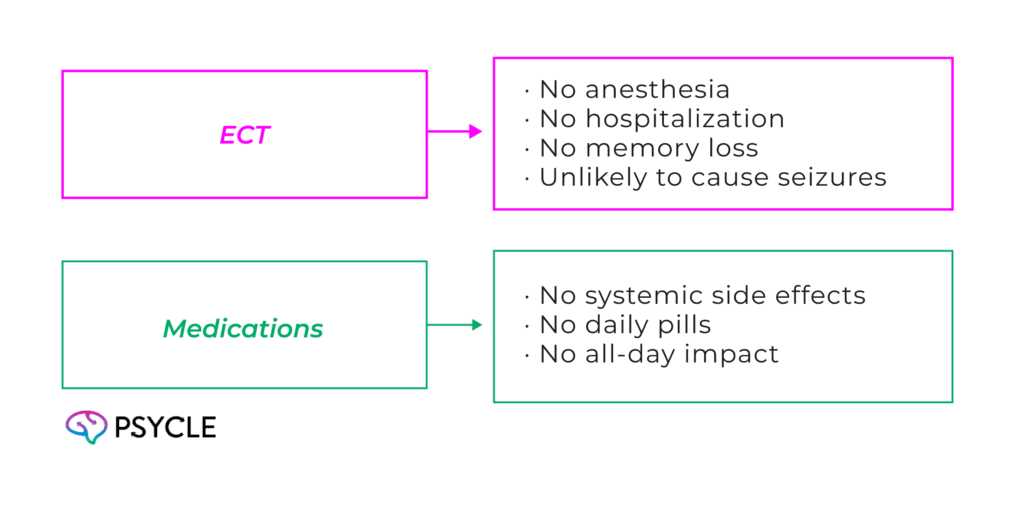
Because no medications or sedation are involved, the treatment avoids systemic effects often associated with antidepressants, and it differs significantly from older treatments like electroconvulsive therapy (ECT).
TMS has become a standard option when multiple medications have failed or produced significant side effects. Many people choose it because the procedure fits easily into everyday life and the sensations remain localized to the scalp rather than spreading throughout the body.
Sensations During TMS Treatment
People tend to describe TMS sensations in concrete, physical terms: tapping, clicking, knocking, or pulsing on the surface of the head. The coil emits a loud snap as the pulse is delivered, and each pulse triggers a brief contraction of muscles or nerves beneath the coil.
These contractions feel like small taps or flicks against the scalp. Some people describe them as mildly annoying; others barely notice them after the first few minutes.
The sound component can be surprising, but clinicians usually provide ear protection, which reduces the sharpness of the clicks. The overall experience is mechanical rather than emotional or overwhelming, and the sensations stop as soon as the machine stops.
Many patients say that after a few sessions, their attention drifts away from the tapping and toward whatever they brought to distract themselves.
Common Temporary Side Effects of TMS
The most frequently reported side effect of TMS is mild scalp discomfort during or immediately after the session. Many patients find these sensations manageable, which can help foster reassurance and confidence in the treatment. This discomfort often appears during the first week and gradually fades as the scalp adapts to daily stimulation.
Some patients report a mild headache that feels like tension in the forehead or temples, and others notice temporary twitching of facial muscles during pulses.
These effects resolve quickly and rarely interfere with returning to work or driving home. Because TMS does not involve systemic medications, it avoids issues like nausea, weight changes, dry mouth, fatigue, or sexual side effects.
People appreciate that the temporary discomforts are predictable and manageable, especially when compared with the unpredictable side effects of many antidepressants. Most patients complete the full course of treatment without interruption.
How Often Does Discomfort Occur?
Studies show that a significant portion of patients experience some level of discomfort during TMS, but the intensity is usually low. Research often cites numbers showing that around a third to almost half of participants report pain or discomfort, yet the average intensity sits in the mild range.
Many people rate it around 3 or 4 on a 10-point scale. These numbers highlight the range of experiences: some people feel almost nothing, while others experience evident but bearable sensations.
A smaller group feels more intense discomfort that requires adjustment. It is helpful to think of TMS not as painless but as consistently tolerable for most individuals. When problems arise, they usually appear early in the course, allowing clinicians to modify treatment to improve comfort while maintaining effectiveness.
Factors Influencing TMS Sensation Intensity
Several factors shape how TMS feels. Coil placement is one of the most important. Certain areas of the scalp have more nerve endings, and some muscles respond more strongly to stimulation.
A coil placed over a highly sensitive spot might produce a sharper tapping sensation, while placement over a less reactive spot might feel quieter or duller. Pulse frequency and intensity also matter.
Higher-intensity pulses can feel stronger, especially at the beginning of treatment, but clinicians typically increase intensity gradually to help the scalp acclimate.
If discomfort occurs, your session supervisor can make adjustments to help you feel supported and in control during your treatment. Individual sensitivity also plays a significant role. People with migraines, tension headaches, or scalp tenderness may feel more stimulation than those without these issues.
Emotional state can also influence perception; those who arrive tense or anxious sometimes experience the sensations as sharper, while people who feel calm often report a softer experience.
Beyond Discomfort: Rare TMS Risks
Although TMS is considered very safe, it carries a few rare risks. The most serious risk is the possibility of a seizure. Still, this risk is extremely low and occurs mainly in people with pre-existing factors (including brain lesions and epilepsy) that increase seizure likelihood.
Clinicians assess on a case-by-case basis whether TMS is appropriate in pregnancy. Comprehensive screening always helps identify and exclude risks before treatment begins.
Other uncommon effects include dizziness or lightheadedness, typically brief and self-resolving. TMS does not cause memory loss, disorientation, or cognitive impairment, which distinguishes it clearly from treatments like electroconvulsive therapy.
Because TMS involves no sedation, patients remain fully alert throughout the session. The procedure’s safety profile is one of the reasons it has gained widespread adoption in outpatient clinics.
The Personal, Subjective Experience of TMS
TMS is a highly personal experience, and the range of reactions reflects that individuality. Some patients describe the first session as startling but quickly adapt and find the tapping predictable.
Others need several sessions before the discomfort begins to fade. A small portion of people describe the treatment as consistently uncomfortable, though not unbearable.
Many say the intensity decreases as the course progresses, partly because the nervous system becomes accustomed to the stimulation and partly because anxiety around the unknown fades.
Because pain is subjective, two people with similar scalp sensitivity can still describe the experience differently. The critical point is that clinicians expect variability and adjust their approach to improve comfort as needed.
TMS vs. Other Treatments
Compared with many alternative treatments for depression, TMS offers a favourable comfort profile. It avoids the systemic effects of antidepressants, which can produce long lists of side effects that last all day. It also avoids needles, anaesthesia, and invasive procedures.
People who have tried multiple medications without success often describe TMS as a gentler option with a predictable routine.
Compared with electroconvulsive therapy, TMS is unlikely to trigger seizures, does not require hospitalisation, and does not cause short- or long-term changes in memory. The absence of cognitive impairment makes it easier for patients to continue work, caregiving, or other responsibilities during treatment.
Many view TMS as a middle ground between mild, low-impact therapies and more assertive interventions.
Guidance for Considering TMS
If you are considering TMS, you can set yourself up for a more comfortable experience by communicating openly with your clinicians:
- If a certain pulse intensity feels too strong, a slight adjustment can resolve it.
- If the coil rests on a tender area of the scalp, even slight repositioning can soften the sensation.
- Ear protection reduces the sharpness of the clicks, and relaxing the jaw and neck during pulses helps lower the perceived intensity.
People often bring a book or a show to watch during the session, which draws attention away from the tapping. Entering the session with realistic expectations helps too. TMS may not feel completely neutral, especially at first, but most patients describe the experience as manageable and worthwhile.
TMS: Balancing Safety, Effectiveness, and Comfort
When deciding to pursue TMS, comfort matters. The treatment rarely causes severe pain, and most sensations sit in the mild-to-moderate range for a minority of patients. Many describe the tapping as unusual but not unbearable, especially after the first several sessions.
Any discomfort that appears usually reduces over time as both the scalp and the patient’s expectations adapt.
In the broader context of depression treatment, TMS delivers a favourable balance of safety, effectiveness, and comfort. While not sensation-free, it remains a therapy people can complete while carrying on with ordinary daily life.
FAQs
Does TMS Cause Severe Pain?
Severe pain is uncommon. Most people describe sensations as mechanical tapping, ranging from barely noticeable to mildly uncomfortable, even during longer or more intensive sessions.
Will I Need Downtime After Treatment?
No. You can return to normal activities immediately since TMS does not involve sedation, and most patients feel well enough to continue their day as usual.
Does Discomfort Mean Something is Wrong?
Not usually. Mild discomfort is expected, and clinicians can adjust settings to improve comfort, especially during early sessions when sensitivity is typically highest.
Sources
- https://www.cell.com/neuron/fulltext/S0896-6273(07)00460-6
- https://www.sciencedirect.com/science/article/pii/S0006322323017420
- https://cdnsciencepub.com/doi/full/10.1503/jpn.230090
- https://www.sciencedirect.com/science/article/abs/pii/S1876201824001254
- https://www.brainstimjrnl.com/article/S1935-861X(24)00158-X/fulltext
- https://link.springer.com/article/10.1007/s12264-024-01283-2
- https://link.springer.com/article/10.1007/s41465-024-00304-2
- https://link.springer.com/article/10.1186/s41983-024-00825-9
- https://www.youtube.com/watch?v=NQHVfF_5rtc
- https://link.springer.com/article/10.1007/s00702-025-02944-w