

Men’s mental health online and offline is subject to forces that differ subtly from those affecting women. Here, we look at how digital spaces support, strain, and shape men’s mental well-being.
Due to ingrained cultural patterns in both online and offline life, many men still feel pressure to remain silent, stay strong, and be self-reliant, even when struggling. Social media amplifies this tension: it can soften stigma for some and sharpen it for others.
Social media has become an integral part of nearly every aspect of daily life. For many men, it offers connection, distraction, entertainment, and information; often all at once. Yet the same platforms that promise closeness can deepen isolation.
All social media can be used to expand access to support, but can also heighten exposure to pressures, comparisons, and harmful norms.
Key Takeaways
- Social media can isolate people as easily as it can connect them.
- Unrealistic standards shape men’s self-image.
- Platform design increases compulsive use.
- Online communities offer belonging and validation, but can also turn toxic.
- Algorithms can concentrate men’s exposure to harmful material, intensifying psychological strain.
- Discernment separates help from harm: trustworthy mental-health resources exist, but not all are equal.
The Illusion of Digital Closeness
For many men, social media presents the illusion of connection without the emotional security of genuine closeness. Scrolling through highlight reels of friendships, relationships, and adventures can actually intensify loneliness. The gap between one’s internal world and the curated lives onscreen can deepen feelings of isolation.
Algorithms also play a role, feeding everybody more of what keeps them scrolling, which is generally not the same as content that would make people feel grounded. Echo chambers can form quickly: groups of people discuss the same ideas, reinforce the same feelings, and rarely challenge them. In some male-centred digital spaces, hostility takes over, or emotional pain disappears into silence.
Men who face harassment or cyberbullying online often withdraw further. Anonymity is typical in these spaces, which can embolden cruelty. A single thread of toxic comments can deter someone from expressing vulnerability again.
The Social Media Standards No Man Can Meet
Chiming with outdated ideas that men should always “tough it out,” social media presents ideals that nobody can really meet.
For men, the pressure often relates to achieving success, looking sharp, and staying confident. Images of sculpted bodies, luxury lifestyles, and effortless careers circulate nonstop. Even with full awareness that a photo is staged or filtered, toxic internal comparison intensifies.
Internal comparison affects physical and emotional self-image. Many men feel increasing pressure to meet aesthetic standards that didn’t exist a generation ago. Others feel inadequate because their lives do not match the curated achievements they see online. Reality stays still, fantasy inflates, and dissatisfaction fills the space between.
Apparent “masculinity norms” also gain traction online. Strength, stoicism, productivity, and dominance appear as unspoken benchmarks. Men who deviate, including those who express fear, sadness, or confusion, may face subtle ridicule or dismissal. Over time, this rigid standard strains mental health, especially for men who need emotional support but feel unable to seek it.
The Most Harmful Social Media Spaces
Some platforms hit men harder than others: Instagram, TikTok, and Snapchat intensify body-image pressures, while X (Twitter) and Facebook fuel outrage and harassment.
Certain Reddit communities and Discord servers reinforce rigid masculinity norms and echo chambers. Algorithm-driven feeds reward virality over nuance, spreading comparison and anxiety. Knowing which spaces carry higher risks helps men curate feeds, limit exposure, and engage with platforms that offer real connection and support.
Designs Fuelling Compulsive Use
Social media platforms are designed to capture attention; notifications reward return visits. Infinite scroll narrows time into unnoticeable slivers. For many men, especially those already carrying stress or emotional discomfort, this creates a form of escape that feels necessary but grows draining.
Concentration fades. Motivation drops. Activities that once brought pleasure feel flat, overshadowed by digital stimulation. It’s a vicious cycle: the phone sparks the stress, and men still tap back in for a fleeting shot of comfort.
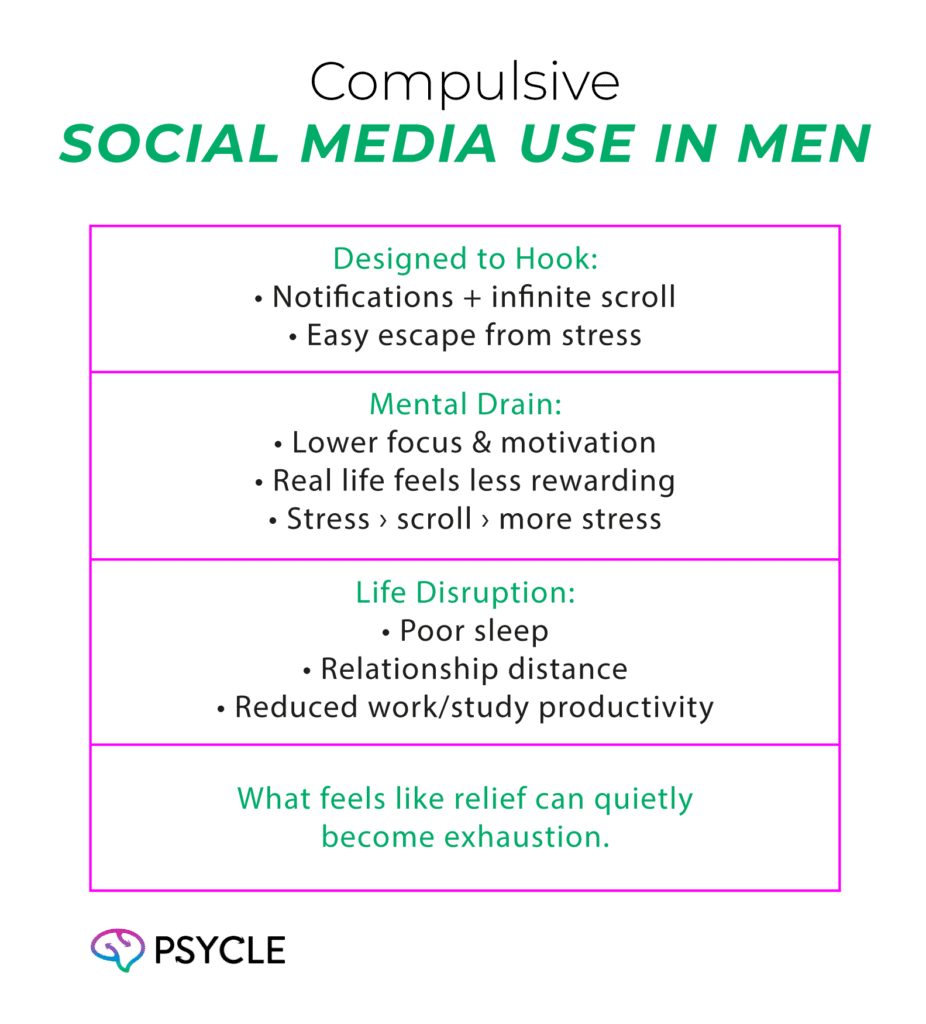
This pattern inevitably disrupts sleep, relationships, and daily rhythms. Late-night scrolling shifts bedtimes later and mornings heavier. Partners may feel ignored. Work or study time becomes fractured. These harmful side effects of social media immersion may become more noticeable over time.
Self-Diagnosis in the Digital Age
Health worries are a prime example of unaddressed issues that social media can magnify. The internet presents an endless array of medical and psychological information to people.
For men who hesitate to seek professional help, turning to social media can feel like a solution. They can explore symptoms, read forums, and follow real-life health accounts without exposing vulnerability offline.
But self-diagnosis carries risk. Misinformation spreads easily. Symptoms overlap across multiple conditions. A man searching for an explanation for low energy or irritability may encounter dozens of conflicting answers, some accurate, others frightening, and some designed for clicks rather than clarity.
Search-derived health insights can also heighten anxiety. When every symptom matches a worst-case scenario online, stress amplifies. Men may turn inward, becoming more worried but no closer to understanding what they actually need. At the same time, reliance on online information can lead to delayed appropriate care.
Risks Amplified by Algorithms
Algorithms shape what men see, often in ways they do not notice. As well as health anxiety rabbit holes, social media is home to misogynistic messages and toxic masculinity, overly aggressive influencers, and extremist narratives, all of which gain momentum quickly. Platforms reward engagement, not well-being. Content that provokes anger, fear, or excitement tends to rise to the top.
For men who are already feeling isolated or insecure, this environment becomes particularly risky. They may gravitate towards echo chambers that reinforce negative self-perceptions or biases about others. They may feel validated by harmful ideas that promise certainty or a sense of identity.
Over time, this can worsen anxiety, depression, or social withdrawal.
Stigma Reinforced Through Masculine Ideals
In addition to increasing loneliness, social media can harden the very stereotypes men use to attempt to escape. Influencers, comment threads, and subcultures often promote narrow, stereotypical images of manhood: stoic, rugged, self-sufficient, and emotionally contained. Some communities reward aggression or dismiss vulnerability as a sign of weakness.
These messages shape behaviour. Men internalise the idea that expressing sadness or asking for help invites ridicule. They silence themselves. They withdraw. They hold emotional pain alone because the digital environment around them discourages expressing it.
This dynamic becomes particularly harmful for young men, who rely on social media as a significant source of identity development.
Digital Spaces Can Also Spark Real Belonging
Not all interactions with social media are harmful. For many men, online communities offer a sense of belonging they cannot find elsewhere. Shared-interest groups, mental-health forums, support pages, and identity-specific communities create pockets of compassion and connection.
Men who feel marginalised in real-world spaces, emotionally, culturally, or socially, often find room to breathe online. They encounter others who share their experiences. They see role models who speak openly about mental health. They interact with people who validate feelings they once suppressed.
Positive social media communities ease loneliness and encourage the first steps toward help.
Access to Reliable Tools and Resources
Despite the risks, social media also expands access to supportive tools. Men can follow therapists, doctors, researchers, and mental-health organisations offering evidence-based information. They can use apps for meditation, sleep, stress regulation, or mood tracking. They can engage anonymously with peer support networks.
These resources meet men where they already are. They reduce the friction of seeking help. For many, this serves as an entry point to deeper support; whether that involves therapy, lifestyle changes, or conversations with trusted individuals.
The challenge lies in distinguishing credible sources from those that are misleading. Quality varies widely. Men benefit most when they approach digital information critically, cross-checking, questioning origins, and using online guidance as a complement, not a replacement, for professional care.
Shifts in Help-Seeking Behaviour
Social media influences how men seek help. For some, digital anonymity reduces the shame associated with mental-health conversations. Online communities normalize openness, and hearing others’ stories can encourage more people to reach out.
For others, the ease of online support leads to delays in truly meeting their needs. Men may rely on forums instead of professionals. They may feel “informed enough” to handle issues on their own. They may remain silent offline, even while actively participating in online support spaces. The healthiest outcomes come from balance: utilizing digital supports while remaining open to professional guidance, in-person relationships, and practices that anchor mental health in daily life.
FAQs
Do Social-Media Platforms Support Men’s Mental Health?
Yes. Used mindfully, social networking sites can provide a sense of community, representation, and access to supportive tools, especially for men who feel isolated in offline spaces.
Does High Social-Media Use Always Harm Men’s Mental Health?
No. The impact depends on the type of content consumed, the level of compulsivity, and the emotional needs driving the behaviour.
What Helps Men Use Social Media in Healthier Ways?
Clear boundaries, thoughtful curation of feeds, engagement with supportive communities, and willingness to seek offline support when needed.
Sources
- https://www.cambridge.org/core/journals/spanish-journal-of-psychology/article/gender-matters-a-critical-piece-in-mental-health/5169A1406DB9BA775E1A6D589674D3F0
- https://www.sciencedirect.com/science/article/pii/S0191886925004210
- https://pmc.ncbi.nlm.nih.gov/articles/PMC9485605/
- https://www.youtube.com/watch?v=pxk3_5lOdic
- https://www.theguardian.com/media/2024/feb/06/social-media-algorithms-amplifying-misogynistic-content
- https://www.pnas.org/doi/10.1073/pnas.2412277121
- https://www.youtube.com/watch?v=4-0ONtDJhNc
- https://pmc.ncbi.nlm.nih.gov/articles/PMC10435997/
- https://www.youtube.com/shorts/Jk_5ENV3vpM
- https://www.sciencedirect.com/science/article/pii/S2666560324000318
- https://www.hopkinsmedicine.org/news/articles/2023/08/social-media-and-self-diagnosis
- https://pmc.ncbi.nlm.nih.gov/articles/PMC7105026/
- https://www.youtube.com/watch?v=EtNh1f_ljwo
- https://www.sciencedirect.com/science/article/pii/S266656032400001X