

Ketamine therapy has grown massively in popularity over recent years, with a proliferation of clinics and retreat centres offering the medicine worldwide.
However, despite being a powerful mental health tool, ketamine remains tightly regulated. It is both a recreational drug and a medicine, so governments have rules to keep people safe while allowing them to access treatment.
In this article, we’ll look at the legality of ketamine across the globe and the specific laws of different countries.
Key Takeaways
- Ketamine therapy is legal in many countries under regulated medical frameworks; recreational use is mostly illegal.
- “Off-label” prescribing means using a drug for a purpose not formally approved, such as using ketamine for depression rather than anesthesia.
- Drug classifications vary: in the U.S., ketamine is Schedule III; in the UK, it is Class B. These classifications regulate use, storage, and penalties.
- Many countries permit ketamine therapy under strict medical supervision.
- Spravato (esketamine) is a regulated version, licensed in some countries for treatment-resistant depression.
- Choosing a clinic requires checking legal compliance, medical oversight, treatment protocols, cost, and follow-up care.
What Is Ketamine Therapy?
Ketamine is a drug with multiple uses. In high doses, it’s used as an anesthetic for surgery, and outside the clinic, it is a recreational drug. In mental health treatment, ketamine can help treat a variety of different conditions, often providing fast-acting and sustained relief.
There are two main therapy models:
- Ketamine Infusion Therapy: In this model, you receive ketamine via an IV drip in a medically supervised setting. A trained clinician gives the drug slowly, monitors your vital signs, and ensures safety. Infusion sessions often last around 40–60 minutes.
- Ketamine-Assisted Psychotherapy (KAP): This combines ketamine with psychotherapy (talk therapy). You take ketamine under supervision, then work with a therapist either during or after the dose. The ketamine helps your brain enter a more receptive state, and therapy helps you process emotions, insights, or trauma. KAP is especially useful for deeper psychological healing.
Both models require trained medical staff and careful protocols for dosing, monitoring, and integration.
Countries Where Ketamine Therapy Is Legal
USA
In the USA, ketamine is a Schedule III controlled substance under U.S. federal law. “Schedule III” means the drug has recognized medical uses but also carries some risk for abuse, so it is regulated more strictly than general prescription drugs.
The FDA has approved ketamine for anesthesia, but not for mental health treatment. However, doctors can still prescribe ketamine for mental health conditions as an off-label treatment. This means a drug isn’t formally approved for a specific purpose, but there’s strong evidence supporting its use.
Private clinics across the USA offer infusions and KAP under medical supervision, or remotely via telehealth. Typically, patients require a mental health disorder diagnosis to receive the medication.
Canada
Like in the USA, Ketamine is a controlled drug under Canadian law. However, it can be used in surgery and can be provided off-label for mental health conditions, given that patients meet a certain diagnostic criterion. Private clinics in Canada offer stand-alone treatments and KAP, but they must have under medical supervision.
United Kingdom
In the UK, ketamine is a Class B drug. A Class B classification means that recreational possession, supply, or sale is illegal and carries serious penalties, though less severe than Class A drugs.
Like the US and Canada, doctors can prescribe ketamine for depression and anxiety as an “off-label” drug. However, doctors must provide careful monitoring and detailed justification to regulatory bodies.
In recent years, recreational ketamine has hugely increased in the UK. As such, regulatory bodies are looking to reclassify the drug to Class A, meaning ketamine therapy will become much more difficult to access if the change goes ahead.
Europe
Rules differ across European countries, but for the majority, ketamine therapy is only legal in supervised medical settings. Some countries, like Portugal, have decriminalization laws in place. This means recreational ketamine use is illegal, but those caught with personal amounts are unlikely to face prosecution.
There are private clinics offering both ketamine treatment and KAP in Switzerland, Portugal, Spain, Germany, and Poland.
Australia and New Zealand
Ketamine is a Schedule 8 drug under Australia’s Poisons Standard. Schedule 8 drugs have strict controls due to potential misuse. Mental health clinics offering ketamine must comply with rules on storage, dosing, and medical supervision.
In New Zealand, recreational use of ketamine is illegal, but doctors can prescribe it for mental health conditions under certain circumstances. Private clinics may provide infusions or KAP under medical supervision. Recreational use remains illegal.
Central and South America
Across the Americas, ketamine is mostly a tightly controlled drug. However, some countries, such as Colombia and Brazil, have decriminalization laws in place for personal use and possession.
In Brazil, ketamine is classified as a B1 controlled substance, meaning that it has medical use, but it’s tightly regulated.
Legal Status of Spravato (Esketamine)
Spravato is a nasal spray consisting of esketamine, a molecule derived from ketamine. In the United States, Spravato is FDA-approved for treatment-resistant depression (TRD) and major depressive disorder with suicidal ideation (MDSI). Only certified clinics can provide the medicine, and they must do so under strictly regulated protocols.
Spravato is legally available in the U.S., Canada, the UK, and some European countries.
Choosing a Legal and Safe Ketamine Therapy Clinic
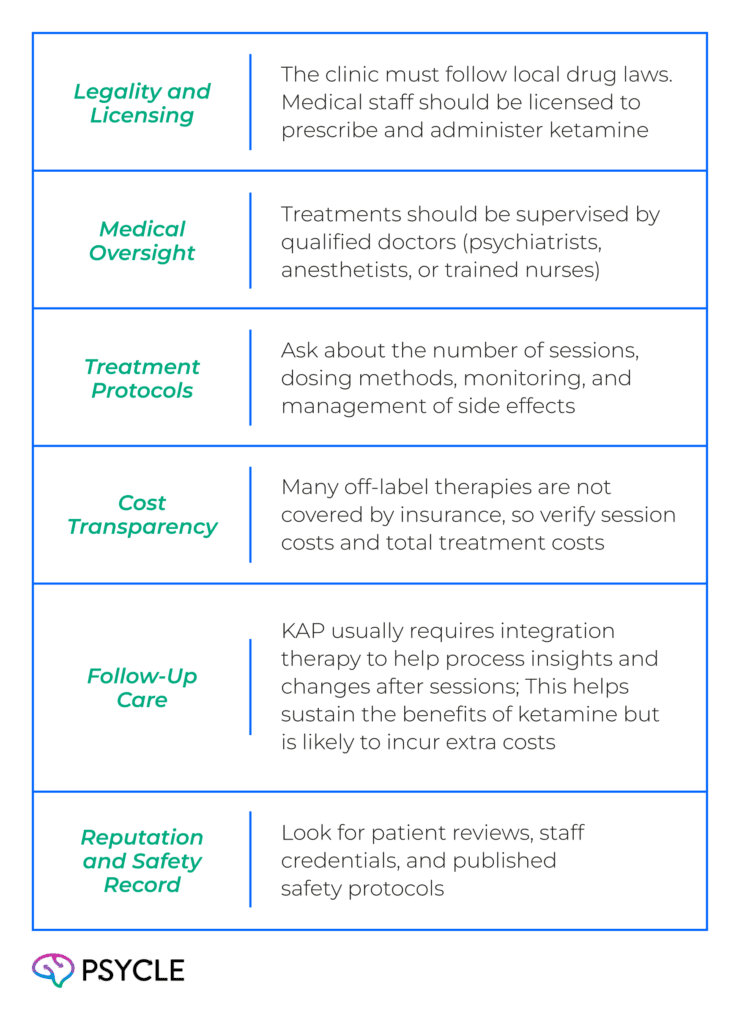
If you’re interested in undergoing therapy, you’ll want to consider legality, as well as other factors:
FAQs
Does Insurance Cover Ketamine?
Most insurance plans do not cover ketamine therapy for mental health conditions. This is because in many countries, ketamine is considered off-label when used for mental health treatment. Spravato, however, is mainly covered by insurance companies.
Do the Same Legal Rules Apply for Both Ketamine Infusions and KAP?
Both ketamine infusions and KAP generally follow the same legal rules regarding prescribing and controlled substances: a licensed medical professional must supervise the administration, and the drug must be handled according to local regulations. However, KAP adds an extra therapeutic component that requires trained therapists in addition to medical staff.
Sources
- https://healingmaps.com/where-is-ketamine-legal/
- https://www.dea.gov/sites/default/files/2020-06/Ketamine-2020.pdf